
Mushroom Recognition
OFELIA at the Mushroom Recognition Competition in Pécs
Istvan Benedek
11/10/20252 min read
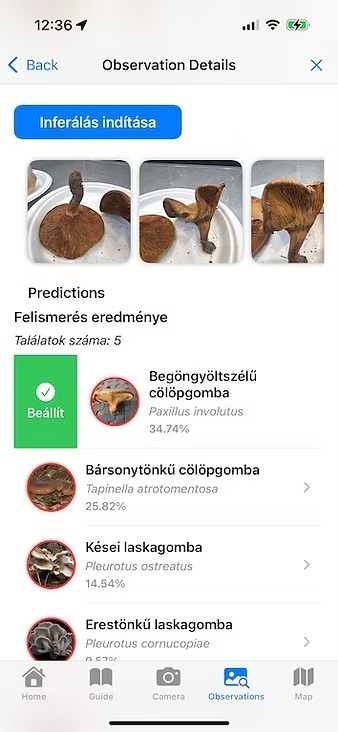

On November 10, 2025, we brought OFELIA to the Pécs Mushroom Recognition Competition, where participants had to identify 30 mushroom species under timed conditions. The scoring system was as follows:
3 points for a correct identification,
1 point for recognizing a closely related species,
0 points for an incorrect answer, and
–5 points for failing to recognize a deadly poisonous species.
Each contestant had 20 minutes to complete the task. Using OFELIA, I managed to reach 17 species within the first 20 minutes, and ultimately finished identifying all 30 species in 46 minutes.
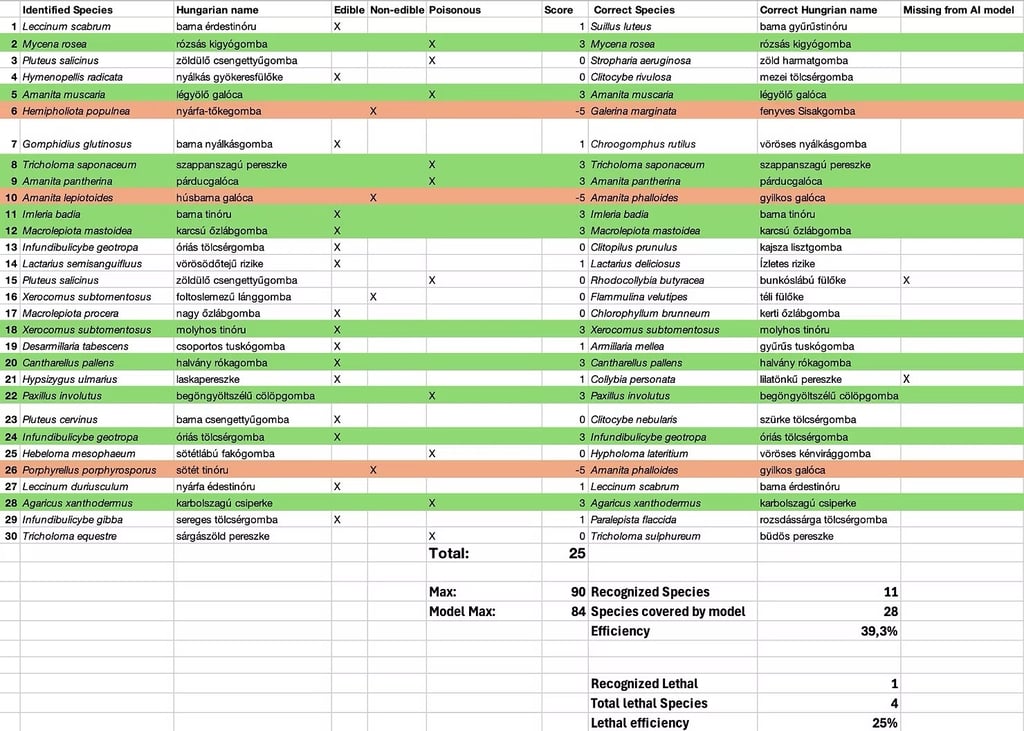
At the venue, Imre Orbán evaluated our submissions. OFELIA — equipped with a model trained to recognize 205 species — achieved 25 points out of a possible 90, as shown in the evaluation table. The breakdown was 40 points earned and 15 points deducted because OFELIA failed to recognize three deadly poisonous mushrooms: two Amanita phalloides and one Galerina marginata. Ouch!
Naturally, I was quite disappointed by the low score, especially given that our model normally exceeds 90% accuracy on its 205 known species. However, several of the contest species were not included in our model’s dataset (see table).
During the competition, OFELIA resized the photos directly for the model without cropping them to isolate the fruit body of the mushroom in the camera’s finder.
The competition was held indoors, where lighting conditions were vastly different from natural daylight.
These two factors revealed an important limitation — the need to handle white balance properly, especially for color-sensitive models.
Later that evening, I implemented cropping and reran all inferences for each observation. The updated results are visible in the table below.
Figure 2. OFELIA’s performance in the competition.
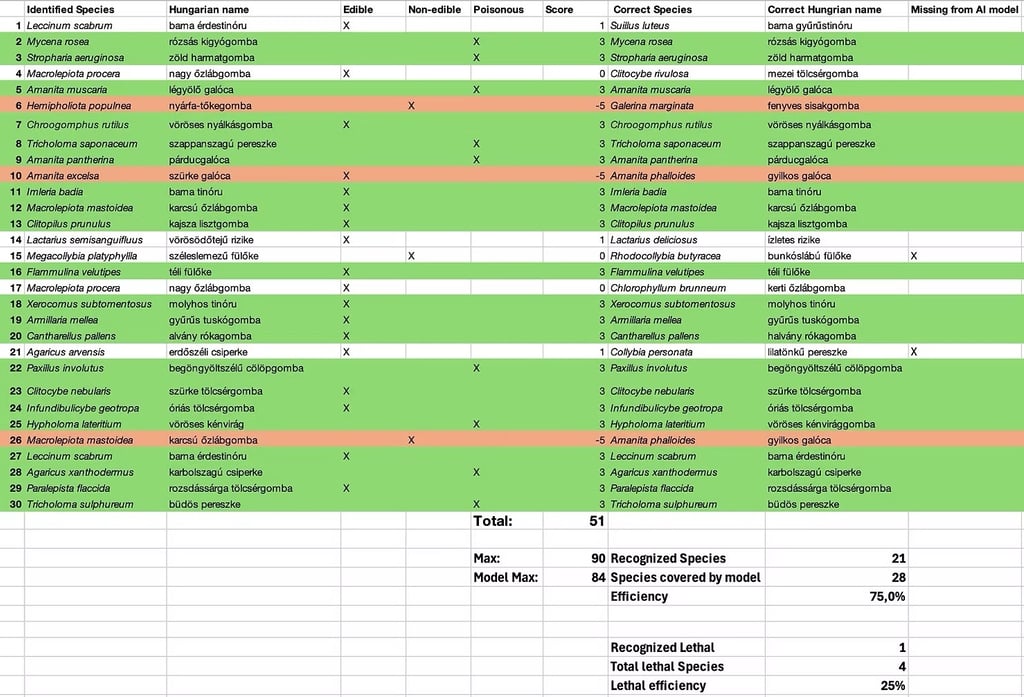
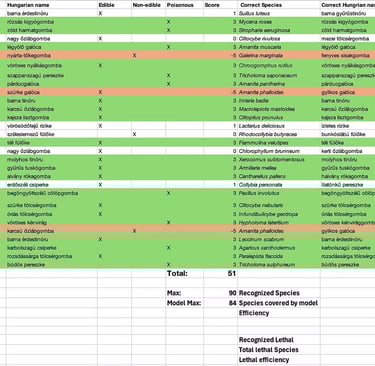
Figure 3. OFELIA’s performance after cropping the center of images.
I should note that during the competition, I did not use the built-in guide; I’m confident that relying on it would have further improved OFELIA’s performance.
Performance-wise, the photo capture process itself was relatively slow:
each image took about 200–300 ms to capture and attach to the observation,
model loading for each inference added ~350 ms,
image preprocessing (resizing) took about 65 ms per image,
and the actual inference ran in only ~2 ms per image.
At home, I optimized the system by loading the model only once and reusing the same instance for subsequent inferences. I also moved the preprocessing to the GPU, which reduced image resizing to 15 ms per image. With these improvements, the entire observation recognition process effectively became real-time.
As of November 11, 2025, these are the key lessons from the test:
Cropping is essential — fixed (✅ implemented).
The model initialization only at the beginning of the process (✅ implemented)
Image resize on GPU (✅ implemented)
White balance must be handled dynamically for color-sensitive models.
The photo capture and recognition pipeline needs restructuring to ensure fully real-time inference during image acquisition.
OFELIA continues to evolve — and every real-world challenge like this brin
Figure 1. OFELIA recognizes Paxillus involutus.
Contact
Reach out for AI and cloud solutions
Phone
info@topclouders.com
+36 30 1378 506
© 2026. All rights reserved.